


MENU

Which dog food topper flavors should brands develop? Explore US launch trends, meat aromas and practical palatability testing for pet product R&D.


Chicken, beef, salmon or liver? An evidence-conscious guide to market trends and flavor selection for powdered food toppers and complementary feeds.
A food topper is added to the animal's regular food, often as a powder, freeze-dried piece, broth or sauce. It may provide sensory appeal or a nutritional function, depending on its composition. Successful formulation depends on aroma, texture, serving size, carrier food and individual preferences.
McCormick FONA's 2025 Top That! report lists the top flavors of US dog and cat topper launches, in this order: chicken, beef, turkey, salmon, lamb, pumpkin, vegetable, fish, duck and pork. This list reflects new product introductions from April 2024 to April 2025. It does not measure sales shares or dogs' actual preferences, and no percentages should be inferred.

Palatability reflects odor, taste, mouthfeel and learned experience. Meat-based ingredients, hydrolysates, fats and organ-meat notes are promising candidates for tests, but no universal flavor has been established as the favorite of all dogs. Marketing prevalence, owner appeal and canine consumption are different outcomes.
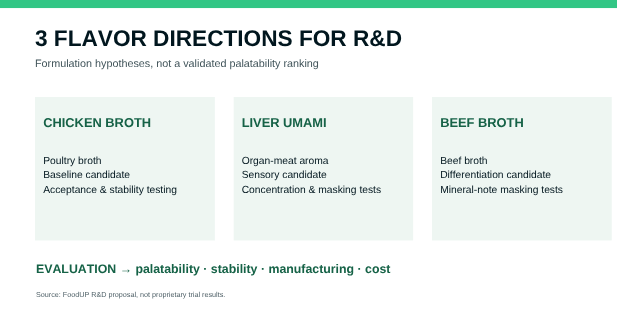
Chicken broth: familiar savory positioning, useful as a baseline powder concept.
Beef broth: a differentiated savory profile and candidate for masking mineral notes.
Liver umami: an intense organ-meat direction worth evaluating, without assuming it will outperform every alternative.
Salmon and fish: recognizable premium positioning with special requirements for lipid oxidation and odor stability.
Turkey or duck: portfolio alternatives, but the species name alone does not support a hypoallergenic claim.
Flavor performance differs between powders, freeze-dried formats and sauces. Powders need control of particle size, dustiness, flow, adhesion, moisture uptake and aroma retention. Sauces introduce viscosity, microbial safety and packaging compatibility. Testing the flavor alone does not validate the finished product.
For a powdered product with minerals or fiber, we would begin with Chicken Broth, Liver Umami and Beef Broth in an otherwise identical base. These are R&D candidates, not a proven palatability ranking. Formulas targeting dogs with gastrointestinal sensitivity need particular attention to digestibility, fat level and safe feeding instructions.
Two-bowl preference and single-product acceptance tests can be used with controlled conditions, sufficient sample size and randomized presentation. Supplement feeding outcomes with stability and sensory measurements after storage. Final selection should account for both animal acceptance and manufacturing feasibility.
A “chicken flavor” claim is not the same as stating that a product contains chicken. Label wording must reflect actual composition. Feed materials and sensory additives have distinct regulatory frameworks. Relevant EU regulations include (EC) No 767/2009 and (EC) No 1831/2003; product claims need to be objective, verifiable and appropriately supported.
Legal sources: https://eur-lex.europa.eu/eli/reg/2009/767/oj/eng and https://eur-lex.europa.eu/eli/reg/2003/1831/oj/eng
FoodUP supports brands with raw-material selection, dosage form design, formulation, competitive benchmarking and prototype-testing plans. For product development enquiries, contact team@foodup.com.pl. Learn more: https://foodup.com.pl/en
What is the most common topper flavor? Chicken leads the cited US launch list, which combines dog and cat products.
Is liver the best choice for picky eaters? It is worth testing, but acceptance is product- and dog-specific.
Can powdered toppers be mixed with water? Often, depending on the particular product's instructions and stability.
How should two flavors be compared? With a controlled feeding study on the same base food.
Is a food topper a complementary feed? It can be, but legal classification depends on composition and intended use.
McCormick FONA, Top That! (2025): https://www.mccormickfona.com/-/media/project/oneweb/fon21/articles/2025/07/pet-food-toppers-trend-snapshot.pdf
McCormick FONA, 2024 Pet Treats Review: https://www.mccormickflavor.com/-/media/project/oneweb/fon21/articles/2025/07/2024-category-reviews_pet-treats.pdf
McCormick Pet Care Flavor Collection: https://www.mccormickflavor.com/-/media/project/oneweb/fon21/pdfs/mfs_pet-care-benchtop-basics-library-2025_.pdf
Regulation (EC) No 767/2009: https://eur-lex.europa.eu/eli/reg/2009/767/oj/eng
Regulation (EC) No 1831/2003: https://eur-lex.europa.eu/eli/reg/2003/1831/oj/eng
Analysis date: 17 November 2026. The launch ranking combines dog and cat products in the USA. Prototype suggestions are FoodUP R&D interpretations rather than proprietary canine trial results.
Checklists of health labels and claims — how not to waste weeks on corrections


