

MENU

How much does it cost to launch your own brand of dog or cat supplements? We compare white label, private label, and custom formulations — from R&D to your first batch.

.png)
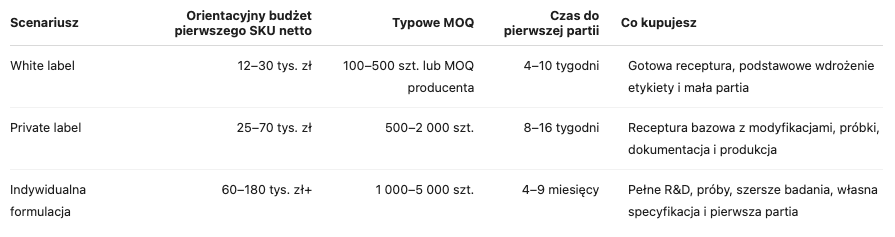
The cost of producing pet supplements typically starts from around PLN 12,000–30,000 net for a simple white label project, usually amounts to PLN 25,000–70,000 net for private label with partial customization, and for a custom formulation, you should expect to spend around PLN 60,000–180,000 net or more. This is the budget to get one SKU to the first batch, not the total cost of building and selling a brand.
The range is wide because the question "how much does a dog supplement cost?" actually involves several different decisions: product form, formulation, batch size, scope of testing, packaging type, and who is responsible for documentation and label compliance. The same product can be cheap per kilogram but expensive to package or test for stability.
The ranges below are estimated net amounts for a single product launched in Poland, based on typical realities for small and medium-sized contract manufacturing projects. They are not a price list or an offer. They assume a product classified as complementary feed for companion animals, standard raw materials, and catalog packaging. They do not include VAT, advertising budgets, e-commerce development, long-term storage, or internal team salaries.
In the market, the terms "white label" and "private label" do not have a single legal definition. Some manufacturers use them interchangeably. Therefore, before comparing offers, you must define the scope of work rather than relying on the model name.
In this article, we adopt the following distinction:
If your project is still at the concept stage, a helpful starting point is the process describing how to design your own pet supplement brand. You cannot accurately calculate a budget without answering at least five questions: what species is the product for, what is its nutritional purpose, in what form will it be administered, what is the daily serving size, and through which channel will it be sold?
Price ranges are not directly comparable without establishing the underlying assumptions. Oil in a pump bottle, powder in a jar, and functional soft treats each involve different technology, risks, and cost structures. The more specialized the form—e.g., soft chews, single-dose sachets, softgels, or products with sensitive ingredients—the higher the MOQ and setup costs tend to be.
White labeling is a suitable choice when your brand's competitive advantage stems primarily from distribution, communication, target group specialization, or an existing community. Since the manufacturer already has the formula and process in place, most technological development costs are eliminated.
The biggest limitation is the lack of exclusivity. A similar or identical product may be offered to other brands. You also need to verify whether the stated "finished product" includes the documentation required for legal labeling and sale, or if it only covers the product mass and packaging.
Private labeling allows you to modify specific elements of a base formula. This could be the flavor, carrier, concentration of a single ingredient, volume, or method of administration. However, each change may trigger new technological trials, recalculation of declarations, and additional testing.
This is often the most effective model for a company that already knows its audience but does not want to fund a full R&D process. The key is to precisely define ownership of the formula, the ability to change manufacturers, and access to documentation. A "dedicated formula" does not necessarily mean the client owns the rights to it or can transfer it to another facility.
A custom formula is justified when the product is intended to test a specific market hypothesis: a different daily serving, better sensory acceptance, a rare combination of ingredients, a specific quality profile, or a unique product format.
The upper limit increases with unconventional forms, expensive active ingredients, animal-derived raw materials, custom packaging, or testing that goes beyond the standard exemption package. If the project requires creating tools, a dedicated matrix, long-term stability tests, or a high MOQ from a foreign manufacturer, the budget may exceed the indicated 180,000 PLN.
R&D is not just about putting together a list of ingredients. It includes selecting their forms, determining the daily serving, assessing technological feasibility, compatibility, palatability, and calculating the levels declared at the end of the shelf life.
Costs rise when the brief contains conflicting expectations: many active ingredients, a small serving size, low unit cost, and a form that the animal will accept without issue. A good formulation resolves these conflicts before raw materials are ordered.
A laboratory sample answers the question of whether the idea is physically feasible. A production trial shows whether the process is repeatable on a larger scale. For powders, factors like homogeneity and flowability are assessed; for oils, oxidative stability and sedimentation; and for soft chews, texture, moisture, and acceptance.
A single free catalog sample is not equivalent to product development. In a custom budget, you should account for several iterations and the cost of raw materials that the manufacturer does not typically keep in stock.
The scope of testing should be based on a product risk analysis. Most commonly, this involves microbiological and physicochemical parameters and confirmation of the content of selected ingredients, as well as testing for contaminants, heavy metals, fat oxidation, or stability, depending on the formula.
There is no single universal "dog supplement test package." A dry mineral product, an oil rich in polyunsaturated fatty acids, and a moist treat all have different risk profiles. Trying to save money by mechanically choosing the cheapest package can make it difficult to defend your shelf-life claims or label declarations later on.
The price of a raw material depends on more than just the ingredient name. Standardization, carrier, origin, quality documentation, bulk packaging size, delivery lead time, and minimum order quantity all play a role. A cheaper raw material can increase the cost of the entire formula if it requires a higher dosage or results in waste from unused packaging portions.
When pricing production, you must determine whether the cost includes mixing, filling, process control, technological losses, labeling, batch coding, master cartons, and palletizing. Comparing only the "price per kilogram" usually leads to incorrect conclusions.
For small runs, packaging can account for a significant portion of the unit cost. A standard catalog jar with a digital label allows you to start at a lower cost than a printed sachet, a box with special finishes, or a custom-colored bottle.
Beyond the price of the packaging itself, you must account for graphic design, technical file preparation, proofs, die-cutting, printing plates, logistics labels, and production overruns. A printer's MOQ is often higher than the product's MOQ, which means some materials will remain in stock until the next batch.
Products commonly referred to as pet supplements are usually introduced to the market as complementary feed. The rules for their marketing, presentation, and labeling are defined by Regulation (EC) No 767/2009 of the European Parliament and of the Council on the placing on the market and use of feed. In practice, the cost of compliance includes product qualification, assessment of ingredients and additives, development of declarations, and verification of marketing communications.
Entities operating in the feed market must also account for requirements regarding hygiene, traceability, and registration resulting from Regulation (EC) No 183/2005 of the European Parliament and of the Council laying down requirements for feed hygiene. Simply outsourcing production to a contract manufacturer does not automatically mean the brand owner has no obligations of their own. Their scope depends on the role in the supply chain, the sales model, and the activities actually performed by the company.
The cost of documentation should therefore include not only the label file but also the product specification, raw material requirements, batch records, product release procedures, and the definition of liability division with the manufacturer. A well-structured quality agreement reduces the risk that a critical process element formally "did not belong" to either party.
The simplest calculation model looks like this:
Implementation budget = one-time costs + (product cost × MOQ) + packaging + testing + logistics + 10–20% reserve
Assume a brand orders 1,000 units of powder, and the total production and packaging price is 22 PLN net per unit. The goods themselves cost 22,000 PLN. After adding 6,000 PLN for development and samples, 4,000 PLN for testing, 5,000 PLN for design and documentation, 3,000 PLN for packaging and logistics costs, and a 15% reserve, the actual budget is approximately 46,000 PLN net, not 22,000 PLN.
It is equally important to calculate working capital. If it takes six months to sell 1,000 units, funds will remain tied up in inventory, and a deposit for the next production run may be needed before the current batch is sold out. Therefore, the cost of the first batch must be weighed against the margin, turnover rate, and payment terms, rather than just the planned retail price.
The choice should depend on where the brand wants to build its competitive advantage:
A good decision-making filter is to ask: will the customer buy this product primarily because they trust the brand and its distribution, or because the product solves a problem in a way that is difficult to copy? In the first case, white label may be sufficient. In the second, skimping on R&D undermines the entire business premise.
The real cost of producing pet supplements is more than just the invoice for finished packaging. For a single SKU, a reasonable starting point is approximately PLN 12,000–30,000 net for white label, PLN 25,000–70,000 net for private label , and PLN 60,000–180,000 net or more for custom formulation. You should add a buffer to every calculation and verify exactly what the manufacturer's offer includes.
The best budget is not the lowest one, but the one that fits your company's current stage. The first batch should validate market assumptions without creating risks that the brand cannot finance or control.
FoodUP can translate your concept into a technical brief, compare implementation models, estimate the full cost of your first batch, and highlight items often missing from basic quotes. This ensures your decision between white label, private label, or a custom formula is based on project economics rather than just the name of the offer.
For a ready-made white label formula and a small batch, you should typically budget around 12,000–30,000 PLN net per SKU. The amount may be lower if the manufacturer offers very low MOQs and ready-made packaging, but you must verify whether this includes testing, labeling, documentation, and delivery.
There is no single market standard. For white label, it can be 100–500 units, while a personalized product often requires 500–2,000 units. With a custom formula or specialized form, the MOQ may rise to several thousand units or be determined by the minimum batch size required for production.
Sometimes the cost of a ready-made formula is hidden in the unit price, or the manufacturer may waive separate fees for sufficiently large orders. This does not mean development is free. You must establish who owns the formula, who has the rights to the test results, and what happens to the documentation if the partnership ends.
For a simple product, the basic scope can cost a few thousand PLN. A broader package covering ingredient analysis, contaminants, and stability can range from ten to several dozen thousand PLN. The scope should be determined by a risk assessment, the formula, the product form, and the declared shelf life.
Yes. One well-chosen SKU usually allows you to verify demand, messaging, and channel economics faster than launching an entire line at once. However, you must ensure that branding, logistics, and customer acquisition costs still allow you to achieve your target margin.
You should not automatically apply procedures for human dietary supplements to pet products. A product classified as complementary feed is subject to feed regulations, and your obligations depend on factors such as composition, presentation, and your role in the supply chain. Before launching, you must confirm the classification and registration requirements for your specific business model.
Most often, it is an unusual product form, expensive or hard-to-source ingredients, high component MOQs, multiple rounds of testing, custom packaging, and an extensive research program. Costs also increase if the intended daily serving size is too small relative to the number and dosage of the ingredients.
ABOUT THE AUTHOR:
Maciej Jaskólski, MSc in Pharmacy
A pharmacist with over 12 years of experience, specializing in the intersection of law, R&D, and business within the Life Science industry. Founder of FoodUP Consulting. As an expert in the implementation of regulated products, he helps investors safely navigate the requirements of the General Veterinary Inspectorate and the realities of contract manufacturing.
In his projects for the pet food industry, he combines a rigorous pharmaceutical approach with a love for animals, ruthlessly eliminating ingredients from formulas that serve only as marketing gimmicks.
His goal is simple: your product must be effective, safe, and profitable – in that order.
Checklists of health labels and claims — how not to waste weeks on corrections